
Each day comes
With thoughts and news
Little things
To bring to you
Like gathering flowers
Picked as I go
I gathered them up
Waiting to show you
Funny or sad
Mundane or rare
Our daily existence
Always shared
Hearts intertwined
An unparalleled linked
Your fabric is mine
What I feel and think
A part of each other
Mother and child
Deepest connection
Melded for life
Agony now
Torn and raw
But enemy death
You are horribly wrong
This sacred love
It cannot die
It lives despite you
Separation’s a lie
Eternally bonded
My mother and me
Soon back together
You wait and see
I’ll be there with her
In paradise, home
Life everlasting
I’ll know and be known
Closer than ever
Death just a door
Into a new realm
More than before
Nearness unshackled
By sin and shame
Two souls communing
My loss is my gain
Only a breath
Between here and there
Until then collecting
Flowers to share
I’m gathering up, Mom
What I know you would like
How my family’s doing
What I’ve done with my life
You told me to write
To enjoy each new day
Good things are coming
You always would say
Grandchildren will bless you
Retirement, too
You and Daryl will prosper
You’ll see it’s true
Mama, I’ll cherish
Your words and your heart
Our special connection
Will carry me far
You’re now there waiting
To share with me
Your daily existence
In a land that is free
Unfettered devotion
Unexplainable love
You long to tell me
What it’s like up above
How Jesus has loved you
Just like I said
How every heartache
Every pain, every dread
Was gone in an instant
When you saw His face
Entering heaven
A miraculous place
I’ll be there shortly
My mother, dear friend
We’ll be together
Sharing life once again
June 20, 2021
Category: Parenting

Solid Ground in Troubled Times
“On Christ the solid rock I stand;
All other ground is sinking sand.”
These words arose in my heart this morning as I was praying and pondering the condition of our country. A global pandemic, civil unrest, violent political division, and economic uncertainty swirled around in my mind.
Our nation has wound itself up into chaos. On the heels of those thoughts emerged the confidence that even though sometimes the world appears ready to spin us right off into space, there is solid ground in Jesus.
The words I recalled are from the hymn, My Hope is Built. It was written nearly two hundred years ago, in 1834, by a man named Edward Mote when he was 37. He had already endured significant personal difficulties and national upheaval in his life.
Born in poverty to parents that were struggling pub owners, he was neglected and left to roam the streets of London.
His family rejected religion, but Edward became a Christian at 15 when he heard a preacher for the first time. Before that he said he was so ignorant that he did not even know that there was a God.
During his early years, he had witnessed the rise and fall of the Emperor Napoleon in neighboring France and England’s war with the newly formed American colonies.
Locally, there was civil unrest over unfair labor practices, and the mass exodus of citizens from the crowded English cities into rural areas, changing the British economy significantly.
As an adult, Edward made his living by cabinet making until he was 55. At that point, he was offered a position as a minister which he gladly accepted, leaving his successful cabinet business.
He became a beloved pastor who never missed a Sunday in 21 years, finally resigning from the church in 1873 due to failing health. He died a year later at the age of 77.
His headstone at the church where he served reads, “In loving memory of Mr. Edward Mote … the beloved pastor of this church, preaching Christ and Him crucified, as all the sinner can need, and all the saint desire.”
Supported in the Flood
“On Christ the solid rock I stand.
All other ground is sinking sand.”
As I sang these words this morning, the first two verses bubble up into my mind. Then, wanting to sing the entire song, I looked up all the verses:
My Hope is Built
My hope is built on nothing less
than Jesus’ blood and righteousness
I dare not trust the sweetest frame,
but wholly lean on Jesus’ name
When darkness veils his lovely face,
I rest on His unchanging grace
In every high and stormy gale
my anchor holds within the veil
His oath, His covenant, His blood
support me in the whelming flood
When all around my soul gives way,
He then is all my hope and stay
When He shall come with trumpet sound,
oh may I then in Him be found
Dressed in His righteousness alone,
faultless to stand before the throne
On Christ the solid rock I stand,
All other ground is sinking sand,
All other ground is sinking sand.
I often wonder what event, joy or heartache inspires people to write songs. As I continued exploring the history around Edward Mote’s lifetime, I discovered something surprising. Something that we can relate to as we battle the ravaging COVID-19 worldwide pandemic.
When Edward wrote The My Hope is Built in 1834, the world was in the throes of a global cholera pandemic. It was the second such outbreak, the first episode beginning in 1817 and ending in 1824. The initial occurrence did not reach England, staying mostly in Asia, but the second one did.
The second bout began in 1826 and by the time it ended, it had taken hundreds of thousands of lives worldwide, hitting hard in Edward’s neck of the woods.
Between 1831 and 1834, cholera killed over sixty thousand in England where the population was fourteen million. Three subsequent outbreaks in Edward’s lifetime took the lives of hundreds of thousands more.
How Hope is Built
When uncontrollable events occur, such as a pandemic, hurricane, the unexpected death of a loved one, or the loss of a job, it feels like we are losing our footing. It seems like we are at the mercy of whatever is coming against us to devastate us. And in a way, we are.
God sometimes allows us to experience the true instability of the world and its systems. He will expose human frailty and limitations.
Traumatic and destabilizing incidents show us that the only eternally solid place on which to build our lives is Jesus and his teachings. Our only security in pandemics, poverty, unstable relationships, traumatic loss, or ungodly governments is in him.
“Everyone then who hears these words of mine and does them will be like a wise man who built his house on the rock. And the rain fell, and the floods came, and the winds blew and beat on that house, but it did not fall, because it had been founded on the rock. And everyone who hears these words of mine and does not do them will be like a foolish man who built his house on the sand. And the rain fell, and the floods came, and the winds blew and beat against that house, and it fell, and great was the fall of it.”
Matthew 7:24-27
Who would have thought that in 2020, scientists and medical professionals would not be able to stop a disease from ravaging every continent?
To date, this novel coronavirus has killed almost 100,000,000 people worldwide. That is a difficult number to even begin to comprehend and the future consequences from those deaths are yet unknown.
The Solid Rock
What a gift Edward Mote gave the world during another devastating pandemic in 1834.
My Hope is Built tells the story of the formidable love of God through Jesus that carries us to safety. It recalls for us the assurance and comfort we have through his protection, not only in the storms of this life, but forever.
We cannot put our faith in “progress”, doctors, vaccines, governments, social systems, or in ourselves. But there is hope! Lasting confidence, joyful anticipation of good, and profound comfort are found only in the person of Jesus and in building our lives on his words.
Now may our Lord Jesus Christ himself, and God our Father, who loved us and gave us eternal comfort and good hope through grace, comfort your hearts…
2 Thessalonians 2:16-17
Share this:

3 Crucial Life Lessons from a Father’s Failure
He fell off his seat backward, broke his neck and died. That’s how life ended for Eli, the high priest.
I’ve read the story of Eli, his corrupt sons, the routing of the Israelites by the enemy Philistines and the capturing of the precious Ark of the Covenant many times.
But today when I read it, it made me cry. For Eli.
Even though this God-appointed priest seems to have started out well, Eli’s forty years in that position did not result in the godly legacy that he might have hoped for.
Failed Fatherhood
Eli’s sons were priests like their father. But the Bible calls them sons of Belial – worthless, good-for-nothings.
They did not know the Lord.
They stole from those who came to offer sacrifices.
They defiled the house of God by laying with the women who served there.
It appeared that they did whatever lustful thing they desired, robbing and abusing the people who came to worship and serve.
How did these rebellious sons get away with their debauchery? Sadly, Eli didn’t hinder them. All he did was warn them that their behavior was deadly, saying,
“If one man sins against another, God will mediate for him; but if a man sins against the Lord, who can intercede for him?” (1 Samuel 2:25a).
But those words of warning did nothing to stop them and the Bible tells us why.
“But they would not listen to the voice of their father, for the Lord desired to put them to death.” (1 Samuel 2:25b)
Why did the Lord want to put them to death? It’s likely because Eli and his sons had been dishonoring God and the people for quite some time. Their time to repent was up.
God sent a prophet to rebuke Eli for putting his sons before God and making themselves fat with the choicest of every offering that the people brought to the sanctuary. God tells Eli that his bloodline will be cut off and his legacy ended in disgrace.
A Great Loss
Eli arrived at the end of his long life a weak, overweight, disgraced man. What sent him over the edge to death was the capturing of the Ark of the Covenant.
The enemy Philistines stole the precious presence of God from their midst. There was nothing left. Eli had been caring for the ark for forty years and now it was gone.
Now Eli was ninety-eight years old, and his eyes were set so that he could not see. The man said to Eli, “I am the one who came from the battle line. Indeed, I escaped from the battle line today.” And he said, “How did things go, my son?” Then the one who brought the news replied, “Israel has fled before the Philistines and there has also been a great slaughter among the people, and your two sons also, Hophni and Phinehas, are dead, and the ark of God has been taken.” When he mentioned the ark of God, Eli fell off the seat backward beside the gate, and his neck was broken and he died, for he was old and heavy. Thus he judged Israel forty years. (1 Samuel 3:15-18)
Eli failed.
He was gluttonous and greedy.
He raised sons who were lustful and treacherous.
He couldn’t protect the ark of God.
Eli lost.
He lost his opportunity to leave a legacy of holiness and fidelity to God.
He lost his sons who the Lord himself killed.
He lost the most precious object on the planet, the ark, the carrier of the presence of God.
He couldn’t control himself.
There are only a couple of times in the Bible that we read that someone is heavy. This is one of them. Eli ate more than the priest’s share of the offerings that the people brought.
He couldn’t control his sons.
Hophni and Phineas were adults, but they were ungodly priests whose behavior should never have been allowed to go on.
I never used to relate to Eli. I saw him as a man who make huge mistakes and paid for it. I saw him as weak but never anything like me. That has changed.
God’s Mercy in Our Weakness
Now that I’m older, and I’ve raised my two sons into adulthood, I see the story somewhat differently. I can relate to Eli’s mistakes.
Maybe I was too hard on my oldest son when he was a teenager.
Maybe I didn’t require enough of my youngest.
There were times when I lacked self-control and raised my voice.
Did I ever place them above the Lord in my heart?
It amazes me that God gives these tiny helpless humans to parents who are so imperfect. In our 20’s and 30’s we haven’t yet learned so many lessons that would make us better parents.
We still tend to be selfish, impatient and lacking compassion. It’s parenting that helps to mature us, but in the process our kids can get hurt.
It’s painful. The past can’t be changed.
I can ask for forgiveness. I can do things differently now. That’s all good. But I can’t alter the consequences that came from my choices.
My hope and peace come from knowing that God loves and forgives and works all things together for good for those who are called and who love him. (Romans 8:28).
I’m grateful for that promise because I need him to work out a lot!
As hard as it is to see my mistakes, it gives me empathy for people like Eli.
The Bible tells us about folks with less than stellar records on purpose.
We relate to their weakness.
We learn to ask for wisdom in our choices, so we avoid the same mistakes.
3 Life Lessons from Eli
- Love and honor God above everyone and everything. Eli and his sons put themselves before God.
Therefore the Lord, the God of Israel, declares: ‘I promised that your house and the house of your father should go in and out before me forever,’ but now the Lord declares: ‘Far be it from me, for those who honor me I will honor, and those who despise me shall be lightly esteemed. (1 Samuel 2:30)
And you shall love the Lord your God with all your heart and with all your soul and with all your mind and with all your strength. (Mark 12:30)
- Don’t wait to turn around. Eli and his sons didn’t turn from their sins.
And I declare to him that I am about to punish his house forever, for the iniquity that he knew, because his sons were blaspheming God, and he did not restrain them. (1 Samuel 3:13)
For godly grief produces a repentance that leads to salvation without regret, whereas worldly grief produces death. (2 Corinthians 7:10)
- Develop self-control. Eli and his sons didn’t restrain their lusts.
Why then do you scorn my sacrifices and my offerings that I commanded for my dwelling, and honor your sons above me by fattening yourselves on the choicest parts of every offering of my people Israel?’ (1 Samuel 2:29)
But the fruit of the Spirit is love, joy, peace, patience, kindness, goodness, faithfulness, gentleness, self-control; against such things there is no law. Galatians 5:22-23
There is Hope
Eli, Hophni and Phineas came to a terrible end.
Sadly, there are people all around us that go down the same road. We see it in the news and in our own backyard. But it doesn’t have to be that way!
If we will surrender our hearts to the Lord, he will give us the ability to love and honor him first and above all and not make our children into idols, serving them first.
The Holy Spirit will lovingly convict us of our sin so that we can repent and be set free from the burden and shame. One day at a time.
He will give us the fruit of self-control so that we do not fall into temptation.
There is always hope!
God sees, knows and cares. We can find encouragement in the fact that he will never stop working all things out for our good and for his glory.
For I know the plans I have for you, declares the Lord, plans for welfare and not for evil, to give you a future and a hope. Then you will call upon me and come and pray to me, and I will hear you. – Jeremiah 29:11-12
Share this:

Preschool Must-Have’s! Top Tips for Choosing the Right Preschool
Your kids are the most precious people in the world to you! At first, it’s hard to imagine giving them to a stranger to care for, isn’t it?
My first experience with preschool was traumatic! I don’t mean when I went to preschool, I mean when my first son did. I was a mess!
There he was, standing at the window waving goodbye while crying his eyes out. I plastered a smile on my face, waved back, got in my car and drove away. Then I let it all out and cried my eyes out, too!
He had a hard time there, so we moved him to another preschool that we were all very happy with. It was some work finding the right one, but it was worth it!
Where our children go to preschool is REALLY important! They are a critical time in their early development. Both positive and negative emotional experiences have lasting impact.
So, it pays to do our due diligence before we decide on preschool. There a lot of great ones out there but also some that aren’t so great.
Once you have a potential school picked out, I strongly suggest doing a classroom observation. A couple of hours or more would be great.
It’s true that a teacher might be on guard if you’re there, however, you can still get a sense of whether the children are happy and if the teacher has created a positive atmosphere.

“Must Have’s” for Any Preschool
DOWNLOAD MY FREE PRESCHOOL MUST-HAVE’S CHECKLIST!
Must Have’s – Preschool Teachers
Are they kind?
Are they patient?
Do they smile?
Do they use positive discipline and redirection instead of yelling, “Don’t!” or “Stop it!”?
Do they use positive verbal guidance instead of just demanding things from the children?
Do they get down on the child’s level when addressing them?
Do they listen to the child’s concerns and help them come up with solutions?
Do they use positive reinforcement of good behavior?
Will they allow observation?
Will they let you stay with your child for a while at first?
Must Have’s – Safety
Outlets covered or out of reach, all cleaning products in locked storage cabinets, no broken tiles or torn carpets that might cause tripping, temperature well controlled, exterior doors that children can’t unlock, bookcases and other climbable furniture bolted to walls or floor, clean sinks, surfaces and toys.
Must Have’s – the Classroom
Most preschool classrooms are organized into centers and a good preschool will have a combination of some or all of these, with variations, of course. I’ve offered examples of some of the equipment and toys that any preschool should have. They are also fantastic for your your home! As an Amazon Associate, I earn from qualifying purchases.
Art Center
Table, easel, paints, paper, staplers, scissors, markers, crayons, glue, seasonal items for holidays, etc.
Music center
Rhythm sticks, cymbals, triangles, bells, drums, autoharp, scarves for movement to music
Science/Discovery Center
Plants, rocks, shells, magnifying glass, balance scales, aquarium, animal/insect cage, small appliances to take apart and explore.
Manipulative Center
Puzzles, open ended toys like Lego or other connecting bricks, collections like keys for sorting, buttons, matching games
Reading Center
Picture books, phonics, first readers, classics, nursery rhymes, books with themes such as colors, shapes, and numbers. (Visit my Usborne Books & More for great children’s books for your home or your child’s preschool!)
Block Center
Wooden unit blocks, hollow cardboard bricks, plus farm animals, small vehicles, etc. to go along with them. Rug for added fun and to keep the noise down.
Housekeeping Center
Child-sized sink, stove, refrigerator, cupboard, pretend foods, dishes, cups, cutlery, pots/pans, telephone, broom and dustpan.
Dramatic Play Center
Dress-up clothes, hats, mirror, dolls and doll beds, armoire/dresser, coat rack.
Other centers ideas: workbench, sand/water play, writing, computer.
Must Have’s – Outdoors
There should be at least 75 square feet of play area for each child surrounded by a sturdy fence. If there is a gate, it’s locked, and children are unable to get out. All equipment in working order with no hazardous areas.
Look for a grassy area and a paved area, climbing equipment of the appropriate size, balls, hoops, ropes, sand/water play, garden, digging toys, ground level balance path/beam, play house, wheeled toys, messy art materials.
DOWNLOAD MY FREE PRESCHOOL MUST-HAVE’S CHECKLIST!
Follow Your Instincts
If you find a preschool that fits the criteria, great job! It might be worth a try. However, always follow your mom instincts. If you don’t feel good about it, even if it fits the basic criteria, move on! There may be something out of whack that you can’t see.
When your child starts the new preschool, stay with them for a while, helping them adjust. If they cry when you leave, it’s normal.
However, if they continue crying long after you’ve gone or every time you leave them there for weeks, I’d consider taking them out. They might not be ready, or you just may need to try a different school like we did.
Remember, there is no rush!! Trust the instincts God gave you as a mom. Enjoy watching your child succeed in his new adventure!
You may want to read my post: 10 Things to Say to Preschoolers to Give Them Courage and Confidence. I tell you how to prepare your child for new adventures.

Thanks for stopping by! Please like, share and pin if this information has been helpful to you!
Share this:

If I Could Have a Stepmom Do-Over
 What was I thinking?! Just before my twenty-seventh birthday, I married a man with two kids who were fourteen and eleven at the time. I had no clue what I was getting myself into.
But I guess that’s the same with anything, isn’t it? You don’t know what’s in the package until you open it.
Sadly, their mom had died. They needed me. The wonderful man God brought my way had been struggling to work a full-time job while trying to be both mom and dad to his kids.
It’s a common scenario.
I was sure that this marriage was God’s will. I wanted to help with all my heart. So, I did.
The next five years were difficult, frustrating and disappointing.
My good-intentioned aspiration to fill a gaping hole in their family with love, security, normalcy and support fell flat.
I had longed to make a home where these two children could heal from the devastating loss of their mother.
It never worked. They snubbed my affection. They rejected my input and railed against how I wanted our home to be.
They were angry at their father for diverting attention to me. They were uncooperative and secretive.
I became resentful and frustrated when they rejected me and my efforts.
Within five years, both of the kids had moved out.
The older went out on his own the minute he turned eighteen. The younger moved to her grandparents at sixteen when we couldn’t manage her anymore.
I felt defeated, frustrated, and helpless.
In retrospect, I see what I did wrong that added to the trouble in our relationship. If I knew then what I know now, I would have done things differently.
Four Things I Would Do Differently
1. Avoid a lot of changes
Personal habits
Both my stepkids’ bedrooms looked like a bomb had hit and everything they owned landed on the floor. Clothes, toys, books, you name it. It was literally a foot deep all over the rooms!
The obviously didn’t know how to keep a clean room, so I was going to help them.
Trying to make them keep their rooms clean was frustrating for all of us and not at all worth it. They didn’t want to change.
I should have just shut the door so I couldn’t see it and saved a lot of aggravation.
Environment
We moved to a new home in a new town with new schools when we got married. It was to reduce my husband’s hour-long commute and to start fresh like many newlyweds do.
Looking back, it would have been better to stay put to minimize the disruption. They had lost their mom.
Uprooting them from home and school contributed to their loss and grief and possibly added to their difficult behavior.
Let the kids keep the same surroundings, schools and friends, if you can. They need continuity to feel safe.
Favorite Foods
My stepkids were used to eating a lot of frozen food, like frozen fried chicken, which I had never seen!
I came from a home with a mom who was a wonderful, Italian cook. So, of course, I wanted to serve them delicious, homemade, healthy foods and that’s what I did.
Never again did would they have frozen fried chicken.
Several years ago, my stepson’s wife told me that he won’t go near chicken and rice or bananas since he had so much of them as a teenager.
That kind of hurt but it also struck me as odd. I didn’t serve chicken and rice that much…and what is wrong with bananas?!
I think his aversion to those foods are more about his aversion to me and the changes I made as a young stepmom coming into his teenage life, than about the food.
If I had it to do over again, I would have continued to serve them what they were used to on occasion, even the dreaded, frozen fried chicken!
Letting them have some of their old favorites would have contributed to their sense of security and normalcy and it wouldn’t have hurt them to eat junk once in a while.
Time with Dad
I remember my husband taking the kids out for “dad time”, but it wasn’t very regular.
In his view, he had spent a lot of time with them after their mom died, and it was time for him to build his relationship with his new wife. We were newlyweds, after all!
I was all for him spending special alone time with them, but after a while, when they rejected me, I stopped trying so hard to encourage it.
I would do things differently now.
Keeping a strong relationship between dad and kids is vital, even if it means you get less time together as a couple.
If they have a good connection with their dad and feel he is giving them some attention, they won’t resent you as much.
2. Don’t take on too much responsibility for their world
I defaulted to the 50/50 parenting partnership model when I got married. It should have been more like 75% on him and 25% on me with my stepkids.
My husband wanted things to be better and he loved my ideas and wanted them implemented. So, that’s what happened! I took on the renovation of the family.
I was all about keeping things clean, so they had their chores. I wanted them to be healthy, so I cut out the junk food. I wanted them to be respectful, so their disrespect never got a pass.
But it would have made for a happier and more peaceful transition if they continued in the way they were running their lives, at least for a while. Even though some things made me cringe!
Why? It would have been less disruptive for the kids and I would have avoided some of the confusion and hurt I felt when they rejected my efforts.
No matter how much you want to help, take a back seat for a while. You’ll be better off.
3. Let their dad handle most issues
Even though you are now an authority figure in your stepchildren’s lives, don’t advertise it!
I worked part time when we got married, so I was the parent who was home the most. Therefore, I engaged more with the kids on a daily basis than their dad did.
I tried to handle the school issues, completion of homework and chores, and anything else that came up.
Being on the front lines made me the bad guy a lot. I got loud push-back from one of the kids and quiet, seething resentment from the other.
I could have used the 1950’s cliche, “Wait until your father gets home!” Not as a threat, but to save myself from having to manage everything that adolescents have on their plate.
Plus, I would have dodged the rejection that they threw back.
Let dad be the enforcer, they already love him and have a depth of relationship clout that you don’t.
4. Don’t expect them to love, respect or appreciate you
I assumed that if I put my heart and soul into being a wonderful stepmom, I will be loved, respected and appreciated in return. How could they not love me?!
When my stepkids were grown and with kids of their own, I had heart-to-heart talks with each of them about those turbulent first years.
I apologized for the things I did wrong and it seemed like it was all good after that. I hoped that since we talked it out we could be closer going forward.
I pictured texting, phone calls, involvement in their lives.
But that was not to be. They’re just not interested in being close and you know what? That’s okay.
I hope your stepkids love you and appreciate your crazy, hard work trying to be a positive influence in their lives.
But they might not and, sadly, that’s not something you can change very easily, or at all. Especially if you make mistakes like I did.
We do our best with what we have at the moment. When we know better, we do better.
I’m confident that God knows our intentions and still counts our good efforts. The results are up to him!
Hindsight
Hindsight is 20/20! I was a young woman with the best intentions, and I gave step-parenting my best shot. It didn’t turn out the way I planned, and even though it was disappointing, I’m okay with it now. I learned a lot about kids and life through that experience.
Remember:
- Relationships are more important than performance.
- If you build the relationship, the respect and love will come and then they are more likely to cooperate with you when you instruct them.
- It’s okay to relax your high standards and just enjoy the journey.
- Every attempt to love, care for, nurture, guide and support your stepkids still counts. No matter the outcome.
Thanks for visiting my blog! Please share and comment. I’d love to hear from other stepparents about your trials and triumphs.
Share this:

4 Things Great Moms Do – Lessons from the Life of Mary
My second child was due on Christmas Eve. It made me feel kind of like Mary, the mother of Jesus.
Knowing how big and uncomfortable I would be during the whole month of December, I had all my Christmas shopping done by Thanksgiving (the first and only time that ever happened!).
After that was out of the way, I had time to ponder what it must have been like for that young girl two thousand years ago. Mary was expecting a child when she wasn’t married.
Scandalous. Miraculous.
Gabriel the archangel announced the coming of her baby, Jesus, and said that Mary was highly favored, blessed, chosen. Different from all the rest.
We only hear a few things about Mary’s life after Jesus was born. But they are enough to give us a glimpse into what kind of mother she became. The unique girl that God chose to be the mother of the Messiah must have some things to teach us about motherhood.
Here are four things that Mary did, and that we can do, to be great moms.

4 Things Great Moms Do
1. Provide a comforting presence in tough times
Your undivided, caring attention is what your children need most when times are tough for them. Put down the phone, stop everything, look into their eyes, give a hug. They need you really present with them, not just in the room.
We know Mary was a comforting presence at the cross when Jesus was dying (John 19:26).
A scene from the movie The Passion of the Christ shows us a couple of things that might also have taken place in Mary’s life as a mom.
In this scene, we watch Jesus carrying the cross down the narrow street in Jerusalem. He was struggling, in agony. Soldiers were trying to move him along with whips and the jeering crowd was yelling insults.
Jesus’ friends had abandoned him, except for a few that looked on sheepishly from a distance. Mary, grief-stricken, stood nearby trying not to watch her son drag himself to an early death.
As he’s straining to take each step, Jesus stumbles under the burden of the heavy cross. In that moment, we see a flashback from Mary’s perspective.
In the memory, Jesus is about two years old. He’s running along a dusty street in Nazareth and suddenly, he stumbles and falls.
A young mother at the time, Mary hurries to his side, like most mothers would. She lifts the crying toddler into her arms and rocks him reassuringly, saying, “I’m here”.
Now it’s Good Friday. Mary watches her grown son stagger and fall to the ground. His body is beaten and battered. He’s exhausted and weak.
Pushing through the chaos of the crowd, Mary rushes to his side, just as she did so many times when he was small. She crouches down next to him to comfort him. Once again, she whispers, “I’m here”.
I could relate to the profound distress Mary would have been feeling. I cried my eyes out the first time I watched that part of the movie! It’s what every loving mother feels when her children are enduring pain.
Even knowing ahead of time that being a mom means experiencing your child’s pain as they do, doesn’t diminish it. Mary was once told clearly and directly that she would suffer along with Jesus.
When she and Joseph took Jesus to the temple to be circumcised at eight days old, a prophet, Simeon had said to her,
“Behold, this Child is appointed for the fall and rise of many in Israel, and for a sign to be opposed – and a sword will pierce even your own soul – to the end that thoughts from many may be revealed”. (Luke 2: 34-35 NASB)
Our first instinct when our children are hurting is to make it all better. However, sometimes we can’t prevent their difficulties, nor should we.
We feel helpless, but it’s through difficulties that our children learn endurance, patience, independence, problem-solving and other valuable character traits that will prepare them for future challenges.
Most importantly, in hard seasons, our kids have the opportunity to trust God for themselves.
Even Jesus, the perfect Son of God, learned obedience through the things that he suffered. (Hebrews 5:8)
Mary wasn’t supposed to prevent her son’s suffering and death on the cross, but she was there with her comforting presence. Maybe even whispering a quiet, “I’m here”. (John 19:25)
Your children need your warm, comforting presence more than anything when they are struggling and challenged.
2. Hope in God, not in outcomes
Optimism is the expectation of positive life circumstances. For instance, an optimistic person expects to avoid things like life-threatening diseases, serious accidents, etc.
None of us wants to suffer and we especially don’t want our children to suffer. However, life is difficult and bad things happen. That’s why we need hope, not just optimism.
Hope is trust in the fact that the love of God holds fast regardless of our tough situations.
God rules the world with benevolence and is watching carefully to work all things together for the good of those who love him and are his. (Romans 8:28)
If we are simply optimistic, challenges can derail us. If we’re truly hopeful in God’s care and concern no matter the situation, nothing can.
Mary was a hopeful, young girl and trusted God when she heard the fantastic messages about Jesus’ future. Gabriel said,
“He will be great and will be called the Son of the Most High; and the Lord God will give Him the throne of His father David; and He will reign over the house of Jacob forever, and His kingdom will have no end.” (Luke 1:32-33 NASB)
Did Mary expect that Jesus would reign on a physical throne in Jerusalem? Most of his followers did. What a disappointment for those whose optimistic expectations weren’t met.
From what we can tell, Mary, was not angry at God or let down when Jesus didn’t reign on a physical throne in Jerusalem.
From the very beginning, we read that she trusted God for even the most unbelievable thing – that a virgin could bear a child.
It’s evident that she trusted God for the rest of the story as well, even when things seemed bleak. After Jesus died, he rose again and is reigning on a heavenly throne. Her hope in God’s word and his love was rewarded.
We naturally have positive expectations for great futures for our kids – and we should. However, life doesn’t go the way we desire, how will we respond?
If we hope in God’s love and his good plan, we have a rock-solid foundation. Despite any of the challenges that we and our children will face in life – sickness, accidents, relationship trouble – this foundation will never crumble.
3. Listen and learn
Several years ago, when I was going through a particularly tough time, one of my sons sent me a song called, “Believe Me Now” by Steven Curtis Chapman.
It’s a song that reminds us that we can believe God’s promises no matter what. It was exactly the reminder I needed at that moment. It touched my heart deeply and changed my perspective from fear to faith.
Jesus was Mary’s son, but also her Teacher.
Once when Jesus was teaching a large crowd, someone told him that his mother and brothers were outside trying to get in. Instead of bringing them front and center, Jesus said,
“My mother and brothers are these who hear the word of God and do it.” (Luke 8:19-21)
In our culture that sounds harsh but was it? Maybe Mary had begun to understand that Jesus was born for a mission that was far beyond her family.
He was her savior as well as her son. The Bible tells us that she was a believer in Jesus as Messiah with the rest of the disciples. (Acts 1:14)
Even small children can say and do things that teach us important lessons. If we’ll humble ourselves and listen, God can use them to give us encouragement, insight and comfort.
Our children might even grow up to be people who change the world with their unique gifting and calling. We can be the first in line to benefit from all they will offer.
4. Let go a little at a time
The moment your child is born you have to start letting go.
It’s not that obvious during the first few years since our kids are so dependent on us. But once they start to venture out into the world, even if it’s only to preschool, we face a challenge.
We have to trust that they will be all right in the care of others. We have to trust that we have given them the tools to navigate on their own.
One day they are learning how to tie their own shoes. Blink and you’re giving them the car keys. Blink again and they’re moving out!
Each step is a challenge for them and for us.
When the angel Gabriel came to Mary with the baby announcement, she knew Jesus would be like no other child ever conceived. However, she still had to learn day by day that his calling and mission superseded his role as her son.
When Jesus was twelve, he stayed behind by himself in the temple at Jerusalem after the feast. His parents frantically searched for days for him after they realized he was missing from the traveling caravan.
When they found him, he was surprised that they didn’t know where he would be. He had to be in his Father’s house. (Luke 2:41-50) He was on a mission from God.
Mary had to let go.
About ten years later, Jesus told the listening crown that whoever hears his words and does them are his family, not just those he grew up with. (Luke 8:19-21)
Mary had to let go.
On that dark Good Friday, Mary’s first-born was fulfilling the purpose for his life which was announced by Gabriel decades before.
He was dragging his cross up to a lonely hill. He was dying, just as he planned.
Mary had to let go.
Our children are gifts from God, but they don’t really belong to us. They belong to God and he has a reason for their lives above and beyond the blessing they bring to our families.
They have a mission from God.
Mary Mindset
Mary was the most important mother who ever walked the face of the earth. Yet, in many ways, she was a mother just like us. She felt the same love, joy, fears, concerns and helplessness that we all do.
Mary learned to mother well. She’s a strong, loving, faithful example that we can look to for guidance on our own journey of motherhood.
The famous Serenity Prayer fits this “Mary mindset” perfectly.
God grant me the serenity
to accept the things I cannot change;
courage to change the things I can;
and wisdom to know the difference.Living one day at a time;
enjoying one moment at a time;
accepting hardships as the pathway to peace;
taking, as he did, this sinful world
as it is, not as I would have it;
trusting that he will make all things rightif I surrender to his will;
that I may be reasonably happy in this life
and supremely happy with him
forever in the next.-Reinhold Niebuhr
I would love to hear the lessons you’ve learned as a mother. Please comment below.
If this post has been helpful, please share!
Share this:

5 Simple Steps to Cutting Your Holiday Stress
Is Holiday Stress Inevitable?
The holidays can be stressful! And they’re starting earlier and earlier every year, like in September, have you noticed?
That means that the stress can start earlier as well.
I searched the internet for “holiday stress” to find advice. The articles I came across were more about what to do once you’re already stressed out, rather than how to avoid the stress in the first place. But it doesn’t’ have to be that way!
We can reduce the holiday stress by doing a few simple things before the holidays run us over!
Some simple preparation and focusing on what’s most important will go a long way to preventing that anxiety from taking the joy out of the season!

5 Simple Steps To Cutting Your Holiday Stress:
Step #1 → Remember the Reason for the Season
Whether you’re celebrating Hanukkah, Christmas or some other special day, remember why. It’s not really about gifts, parties or food!
Christians are celebrating the birth of Jesus Christ, the Son of God, on Christmas. He was born over 2000 years ago in an ordinary stable in a small town and laid in the animals’ feeding trough to sleep. Though he was King of Kings, he came as a humble child.
This scene of peace is meant to point us to the Savior of the world. We celebrate his birth because of what his coming to earth meant for the world – salvation. Not just at Christmas, but always.
For unto you is born this day in the city of David a Savior, who is Christ the Lord. (Luke 2:1)
Whichever reason for the season means the most to you, if you keep it in the forefront of your mind, the stress of the season is less likely to overwhelm.
Step #2 → Schedule Family Times First
Schedule dates for your own family traditions and gatherings before committing to other holiday events. That way, it’s less likely these cherished family events don’t get pushed out by a company party you have to attend or a church volunteering commitment.
Your children will treasure these special family times forever!
You might also be interested in my 20 Fun and Meaningful Holiday Family Traditions for some ideas for memories you can create.
Step #3 → Schedule Outside Events After Family Events
- Make sure everyone in the family is aware of the schedule, so you don’t overbook and stress out!
- Post a physical calendar in a common location, so it’s in plain view every day.
I found a fun calendar that’s also super practical: Sandra Boynton’s Mom’s Family Calendar.
The days are in horizontal lines, instead of little squares, giving plenty of room to add everyone’s important happenings!

Here are some of the activities that you might need to add to your calendar during the holidays:
- Parties with friends
- School productions
- School parties
- Special religious services
- Volunteering
- Work-related parties
- Vacation days
- Extended family gatherings and more!
Step #4 → Prepare Meals Ahead and Freeze Them for Busy Nights
Make a double batch of dinner for several nights and freeze half. Then all you have to do is defrost!
If you really want to get ahead, make a couple of weeks or a month’s worth and glide right through the holidays!
Here’s a super popular cookbook that takes it to that next level. You can see more here.
![Not Your Mother's Make-Ahead and Freeze Cookbook Revised and Expanded Edition by [Fisher, Jessica]](https://images-na.ssl-images-amazon.com/images/I/51GuNjIrfeL.jpg)
Step #5 → Give Yourself a Break!
Add relaxation, rest and rejuvenation into your schedule.
- Schedule time that isn’t focused on the season. Not everything has to be holiday-themed! Take a break.
- Exercise. It’s a stress-reducer, especially if you can get outside and enjoy the fresh air and beauty around you at the same time.
- Don’t trade sleep for tasks. Your body needs good rest to replenish its stores of energy. Pare down the schedule if it’s interfering.
- Eat well. We sometimes grab what’s in front of us when we’re busy and it’s usually not that healthy. Keep fresh fruits, veggies and nuts around for energy-giving snacks.
- Relax. Get a quick 15-minute shoulder and neck massage while you’re at the mall or schedule and hour! Or, click here to treat yourself to one of these so the gift just keeps giving! My son gave me one of these neck massagers this year and it’s an oasis of relaxation!

- Remind yourself that you’re not in a competition. In many ways, our culture has manufactured the stress of the holidays. You don’t have to participate in the race!
- Accept that you can’t do it all. It’s just not humanly possible to accomplish everything on the to-do list before Christmas. It’s OK!
- Enjoy! laugh and have fun as much as you can. If your kids are small, ignore their tantrums (they get stressed, too) an focus on the wonder.
Hope these 5 Simple Steps To Cutting Stress Out of Your Holidays have helped you!
If so, would you please share this post? Thank you!
See also: 20 Fun and Meaningful Holiday Family Traditions
I’d love to hear some of the ways you cut stress during holidays in the comments below.
Share this:

20 Fun and Meaningful Christmas Traditions
One of the best things about the Christmas season is the memorable things we do year after year. Our Christmas traditions.
Large and expensive or small and free, it doesn’t matter. They are meaningful because they’re shared with those we love.
We count on our Christmas family traditions to bring us together with those who mean the most to us.
When my first son was small, we started the tradition of fixing hot cocoa, bundling up and driving around looking at the Christmas lights and decorations in our city.
I can still see the little redhead in his car seat in the back, pointing in awe while taking an occasional sip of his lukewarm cocoa from his sippy cup.
When our second son arrived, he joined in. His first word was “light”, which came out more like “ight” and he, too, marveled at the “ights” at Christmas.
Truth be told, a couple of decades later, we’re still doing the drive. I make the cocoa or we go to the local coffee shop and get it. Either way, it’s a tradition. We’re just waiting for the next generation to join in.
Because I love Christmas family traditions, I thought I’d offer a few ideas in case you’d like to start some of your own or add some more to your list!
20 Fun and Meaningful Christmas Traditions

#1- Cut your own Christmas tree and then go to a great family restaurant
When I was a kid, we lived not far from hundreds of tree farms. After we’d choose our tree, we’d eat dinner at a restaurant called Negri’s. It’s an old school Italian restaurant which has been in operation since 1943.
What wow’d me as a child was that they serve 1/2 ducks. Plus you also got minestrone, a mixed green salad, antipasto, ravioli, salami and French bread. My Italian genes (20% according to Ancestry) were in heaven!
The warm memory of those incredible meals after choosing the perfect tree is one of my best childhood memories.
#2 – DIY Christmas decorations party
Invite the neighbors and have a DIY decorations party. Even the littlest ones can join in with a little preparation!
Check out this fun felt wall hanging Christmas tree with ornaments and gifts that the children stick on themselves! So adorable! You can get a closer look here.

#3 – Hang lights in each child’s bedroom
Kids love having their own rooms decorated for the season.
Aren’t these star curtain lights fun?! Accent lights add a warm ambience to any room and they’re so much easier than hanging outdoor lights if you just want that festive feeling!
Plus, they are perfect to keep up all year! Check them out here.

#4 – Cuddle up for a Christmas movie night with popcorn (to string or eat!)
Before you could buy movies for home use, we’d have to wait all year to watch our favorite Christmas movies. Hard to believe!
Now they’re just a click away on Amazon Prime Video. Here are my favorites (click to download):
And of course, The Grinch Who Stole Christmas.
Be the first to get the new “Illumination Presents: Dr. Seuss’ The Grinch” by PREORDERING!

#5 – Wrap gifts together add one thing you appreciate about the recipient on the tag
We normally wrap a gift and write the simple “To” and “From” tag without much thought. How about adding one thing you appreciate about the recipient?
#6 – Christmas light display drive – with hot chocolate in hand
This is one of my favorite traditions that never expires! My 22 year old still comes with us after doing it for his whole life!
Get your hot chocolate and find the most beautiful displays in your neighborhood.
Here’s a great homemade hot chocolate recipe from Martha Stewart. It’s yummy!
#7 – Go to the movie theater as a family (the best movies come out this time of year)
Some of the very best family movies are released at the holidays. Gather the clan and enjoy the show!
#8 – Watch a live production of The Nutcracker ballet and have tea after
There’s nothing like a live performance of any play, opera or ballet! The Nutcracker is blessed with an incomparable musical score as well. Take the kids and then go have a spot of tea afterwards!
#9 – Ice skate outdoors in the big city nearest you
It doesn’t really get icy in San Francisco, the largest city near us, but every year they form an ice rink downtown for skating. You can skate in relatively warm weather (in the 50’s) around here!
There’s something about going into the city at the holidays with the big department stores all decked out that makes for a memorable experience! Even if you don’t skate, it’s a worthwhile outing.
#10 – Join the local church for Christmas caroling or have your own sing-along
It’s so much fun surprising your neighbors with Christmas carols wafting down the street. This time of year most folks will answer their doors. I’ve even been invited inside! Lots of fun for the whole family.
The holidays can be stressful along with all the fun!
Check out this post:
5 Simple Steps to Cutting Your Holiday Stress

#11 – Volunteer at a toy drive distribution or wrapping
When the fire department holds toy drives, they often need help wrapping the gifts. Why not join in? This is an easy activity and it connects us to our community.
#12 – Serve meals at the local homeless shelter
Serving food to those who have less than we do is wonderful to do with the older children in your house. It will teach them service and gratitude.
There is nothing like getting a little more persona with those that we sometimes just pass by on the street corner.
#13 – Read A Christmas Carol by Charles Dickens
A Christmas Carol is the quintessential, classic Christmas story that everyone should read (besides seeing the movie)!
It gives us the lessons of appreciating what we have, those who love us and teaches us about the blessings of generosity.
This edition of A Christmas Carol is just released and includes holiday recipes from some favorite chefs:
Giada de Laurentiis, Ina Garten, Martha Stewart, and Trisha Yearwood!
Click here to get a closer look.

#14 – Read the Christmas story together on Christmas eve
Here’s a favorite Usborne Nativity Flap Book to give kids 3+ an introduction to the Nativity, the birth of Christ.
Click Here to see this title.
See many more books in for every age and interest at my bookshop: www.blaircottagebooks.com.

#15 – Go to the grocery store together, choose non-perishable foods and drop them off at your local food bank
Children love to make their own choices and what better than to have them choose food to give to others this year?
Even a three-year-old can choose food for those in need. Buy canned goods, rice, beans and other staples.
#16 – Camp out under the Christmas tree
Since camping is out of the question during the winter months, why not haul out the sleeping bags and camp out under the Christmas tree one night?
The twinkling lights will act like night lights to make it feel safe. If the younger ones get scared, they can always crawl into their cozy beds.
#17- Set up a nativity scene and talk about each piece
Purchase a nativity set with the stable, Mary, Joseph, baby Jesus, the animals and shepherds.
Set up the scene and discuss the significance of each piece for a lesson in the true meaning of Christmas. This set I found is one of the loveliest I’ve seen.
It will be treasured for years to come with its 16 detailed figures and stable and even the gold, frankincense and myrrh!
 Click here for details.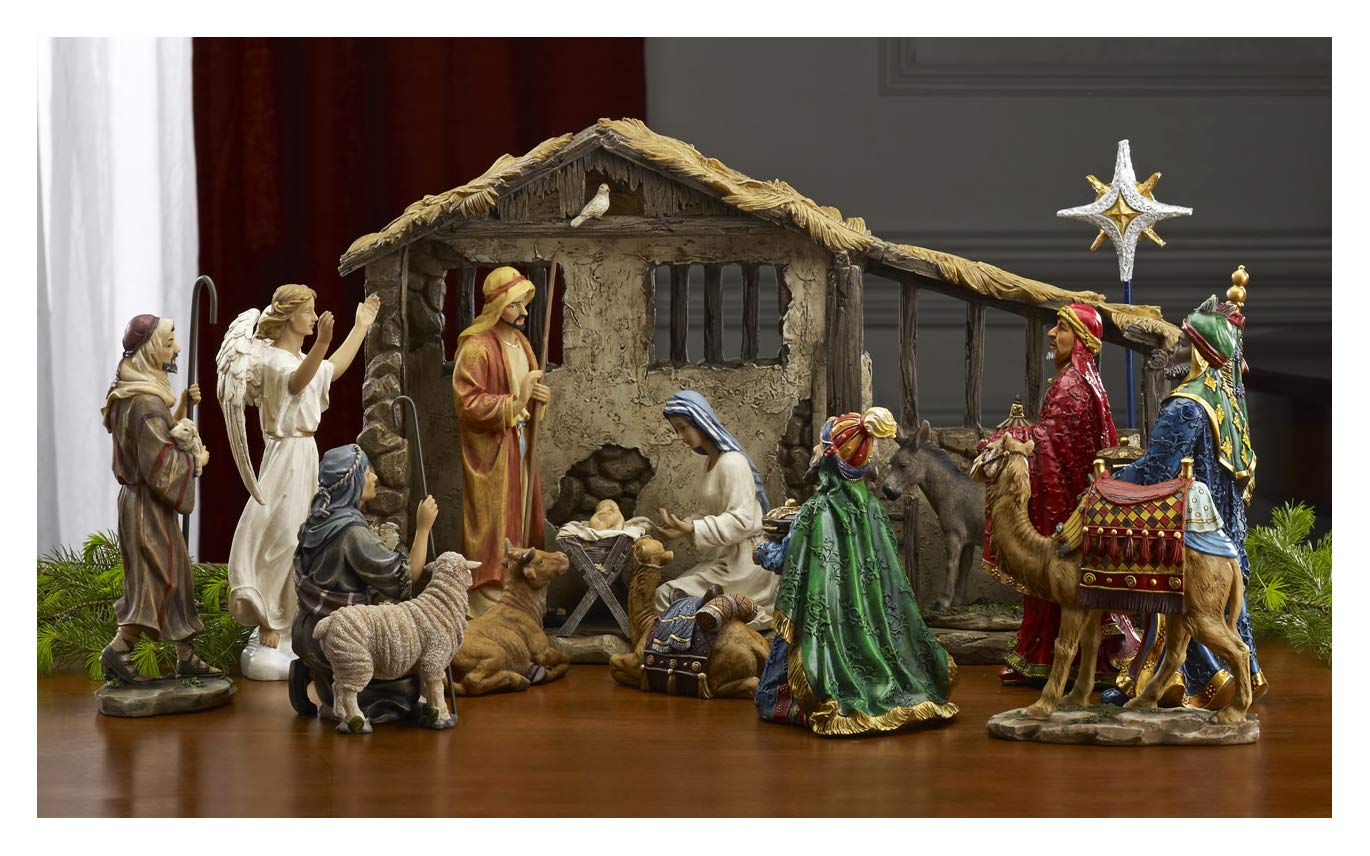
#18 – Take a photo with Santa – with the entire family
Why should the kids get all the fun? As long as you’re all waiting in that long line, you might as well get in the picture.
Besides, it’s one way to be sure you get your yearly family portrait!
#19 – Listen to a live performance of Handel’s Messiah
Anyone who has been to hear Handel’s Messiah will attest to the heavenly experience it is.
A bit long for younger children (under eight), but it is a unique opportunity for older children to hear classical music at its finest with the spirit of Advent theme.
Local choirs usually put on a performance during December.
#20 – Attend a Christmas Eve or other service at a different place of worship than your own
I have clear memories of our midnight mass on Christmas eve at our Catholic church in the neighborhood where I grew up.
It was the only time I ever stayed up that late! Which meant it was a special occasion, for sure.
There was a hush over the congregation as the priest read the gospel story of Jesus’ birth.
We now attend a church that is much different, but occasionally I like to visit somewhere different and be reminded that there are many ways to worship.
Whatever your Christmas traditions, may they bring your family closer together, give them a sense of community and teach them more about their faith.
Please share this post if it’s been helpful to you!
I’d love to hear about your own family traditions in the comments below!
Share this:

10 Things to Say to Preschoolers to Give Them Courage and Confidence
If you know preschool children, you know that they naturally love to explore and discover. That’s one of the things that make them so lovable.
Everything with them is new and exciting.

But they can quickly lose this sense of adventure when they encounter challenging, unfamiliar situations unless they have grownups around them who coach them through and show them they can do it!
It’s a scary thought, but the way we communicate with our children in these sensitive moments could be the key to their sense of self-confidence for the rest of their lives.
If we are equipped with what to say in sensitive, childhood learning moments as well as everyday moments, we are preparing to launch brave, happy, confident people into the world.
In the first 5 years, many vital milestones occur in children.
Psychologist Erik Erikson developed a theory about stages of human psychosocial development. The first three stages he explains are from infancy through the preschool years.
The first stage is Trust vs. Mistrust
Caretakers, by their treatment of a child under the age of two, teach the child that people are trustworthy or not. This gives the child a basic sense of security or insecurity.
The second stage is Autonomy vs. Shame
This stage takes place up to about four years of age. A child raised well in the first years will develop a sense of assurance, control and independence.
The third stage is Initiative vs. Guilt
In this stage, through the preschool years, the child learns to engage in imaginative play, cooperate with others, lead and follow well.
When fear and shame are predominant emotions, the child will instead be restricted in play skills, may hang back and not participate with others and continue earlier levels of extreme dependence on the parent.
If you’d like to read more about the psychosocial stages, you can buy his book, The Lifecycle Completed, by clicking this link. (By the way, as an Amazon associate, I earn with purchases at no extra charge to you).
If the adults in a child’s life can foster security, self-assurance and courage in children, we will be setting them up for future success.
10 Things to Say to Preschoolers
to Give Them Courage and Confidence
Here are 10 major areas where we can affirm, encourage and instruct our children.
If we use phrases like these in these early years, preschoolers will develop the courage and confidence to move out into their new adventures knowing they have what it takes!
1 – Security – let them know they are safe – it’s the foundation for their growing independence.
Say this: You are safe. Mommy and Daddy love you and will always take good care of you.
2 – Confidence – remind them of past successes and assure them they can succeed in new circumstances.
Say this: You can do this! Remember when you went to the play group and did great?
3 – Individuality – let them know they are unique and specially gifted.
Say this: You are such a friendly kid! You’ll be good at making new friends.
4 – Support – let them know you will always be rooting for them.
Sat this: No matter what, I will always be there when you need me.
5 – Emotions – let them know that their feelings are normal and then help them work through them.
Say this: I can see you’re feeling angry right now. I can understand why. It’s hard for us when we don’t get what we want.
6 – Choices – Even when they can’t have what they want, making a choice gives them a sense of freedom and power.
Say this: We’re not having candy right now. You may have cheese or apple slices. Which would you prefer?
7 – Responsibility – let them know that their choices have consequences.
Say this: You can get your blocks out, but you will need to put them away when you’re done.
8 – Creativity – let them know their special, unique creativity is noticed and appreciated. Pick out one or two particular aspects of their work and praise them for it.
Say this: I love the combination of colors you chose for the feathers in your painting.
9 – Character – let them know when you see their positive character traits. We often only acknowledge misbehavior. Catch your kids acting right and point it out.
Say this: You were very kind to share your favorite toy.
10 – Worthiness – let them know that what they do and who they are is worth your time and attention, even if you can’t stop everything and pay attention right now.
Say this: I really want to see your tower of blocks. It’s important to me. I’ll come take a look at it in (5) minutes.
Here are some books and add-ons that help preschool children with a positive self-concept. Click on the title for more information.
Jonathan James and the Whatif Monster by Michelle Nelson-Schmidt. Helps kids face new and sometimes scary situations with confidence.
Whatif Monster Plush Toy Companion to the book, this stuffed Whatif Monster is for kids to tell their fears and worries to.
Cordelia by Michelle Nelson-Schmidt. Lets kids know they are capable.
Cordelia Doll Companion to Cordelia story to remind kids that they can do it like Cordelia did!
I Love You Hoo by Rachel Bright. Sweet read aloud expressing love for children just the way they are.
You Are A Star by Ariella Abolaffio. Encouraging read aloud to instill a positive sense of self.
Here are some books to help grownups understand and communicate better with their kids. Click on the title for more information.
The Lifecycle Completed, by Erik H. Erikson. Understanding child development is important to parenting.
How to Talk so Little Kids Will Listen: A Survival Guide to Life with Children Ages 2-7, by Joanna Faber and Julie King. Teaches parents positive communication skills that will get results.
Preschoolers Are Ready and Willing Adventurers and We Can Help

Preschool children love to venture out and try new things, but they need grownups around them that give them a strong foundation and cheer them on as they go.
The messages we send them, verbal or otherwise, become the foundation upon which they build their sense of self for a lifetime.
Children are subconsciously asking these questions all the time:
Am I safe?
Am I lovable?
Am I important?
Am I enough?
Let’s do everything in our power to make sure that they can answer those questions with a big “Yes”!
What are some of the ways that you instill confidence in your kids? I’d love to hear in the comments below!
If you enjoyed this post, please share and follow. Thanks!
Share this:

Hope for Unhappy Stay at Home Moms

You have the greatest job on earth and you know it.
Most days.
Other days, you’d rather just stay in bed and pull the covers over your head, screaming silently (or aloud!), “Leave me alone!!”
But, of course, you don’t stay in bed. Precious little ones are putting their adorable faces right up to yours and saying, “Mommy, I’m hungry” or your infant is crying.
Commitment and instinct rule the day and you drag yourself into the bathroom to start the all-too-familiar routine over again.
You brush your teeth, throw your hair into a pony tail, wash your face, don some jeans and a t-shirt and wonder when you’ll be able to fit in time for a shower. Taking a long, hot shower has become the extent of luxury in your life.
Before you know it, you’ve put in your first load of laundry, fixed a quick breakfast for the kids and now you’re sweeping Cheerios off the floor.
That’s how you begin another exhausting day of meals, cleaning, wiping rear ends and noses.
There is also another battle going on. The one that can’t be seen.
I chose this life.
I know it’s best.
I love my kids.
But…
I’m bored and frustrated.
I feel undervalued and unappreciated.
I feel guilty for taking it out on my kids.
How dare I be down when I’m so blessed?
I don’t want to give up.
I can’t give up.
But how can I continue when I’m so unhappy?
Our Challenge
Some days are easier than others. There are plenty of days when our hearts are full, and all is well. But even then, there can linger an underlying sense that we are missing out on something that a job outside the home would give us.
Many stay-at-home moms feel undervalued and unappreciated by society and maybe even by their family and friends.
Those who had a high-paying, prestigious job before deciding to stay home might miss the daily, positive feedback they received. There are no paychecks, glowing annual reviews, raises or Christmas bonuses for a stay-at-home mom.
For others, the unknown can be just as trying. “What if I had a career instead of this. Maybe I need to get out there and make something more of myself.”
There’s little positive feedback. That’s why leaving the home can be so tempting.
The Hidden Issue
I don’t think our choice of vocation or the lack of positive feedback is the real problem. Even moms that our culture applauds for succeeding as “go-out-and-work” moms can feel inadequate, and many do!
The cause of our discontent is not found in what we’re doing.
It’s found in what we think about ourselves while we’re doing it.
Long before we have children and decide to care for them full time at home, we can have an underlying feeling of not being good enough.
This year I’ve been looking at my childhood as I’m working through some negative self-perceptions that I’ve carried around all my life.
My dad was a fun-loving Irishman with a great sense of humor and he loved his family. However, I’m seeing now that he lacked the good communication and parenting skills that would have made me feel valued and important.
When I was four years old, my dad decided that I would no longer go with my mom when she went shopping. He thought I was getting spoiled.
My mom has a memory of me standing on our porch, crying as she drove away. It must have been hard for her, too. But she didn’t argue with my dad. I remember feeling scared, confused and alone.
If my dad had taken me inside and played a game or read a book with me, it might have lessened the sting of rejection. But he was not that type of dad.
So, I was left standing there on the porch believing I’m spoiled (I’m sure I had no idea what that meant), something is wrong with me and whatever was going on, it was all my fault.
Circumstances like this root deep into the minds of children who naturally lack the maturity to process them in a way that prevents those negative perceptions of themselves. They hear:
“I’m bad.”
“Something is wrong with me.”
“I have to be better so that dad will be happy with me.”
Those are the messages that we take with us as we grow up. We keep trying to prove our worth by performing to win approval. We hope it will make us feel better about ourselves.
We finally realize after wearing ourselves out, that no matter how well we perform, it doesn’t seem to take away the sense that we don’t quite cut it.
The Healing
I recently read a book called The Soul of Shame by Curt Thompson, M.D. It’s full of insight into the areas of the brain, shame, unworthiness and how to heal.
Dr. Thompson explains how our brains are literally wired when we are children in response to the way we are treated. If we’re not validated by the people closest to us, even before we were born, we internalize shame and lack of self-worth.
The great news is that our brains can be rewired by replacing the negative thinking with the positive. It’s simple, but not necessarily easy and won’t happen overnight. However, it’s worth it!
One of the reasons that I love children is because they are naturally unashamed, full of love and free. I want to be that way, don’t you?
There’s hope! We can restore that childlikeness that makes every day an adventure and turns work into play. It’s never too late.
First, start by replacing the destructive recordings in our mind with these truths:
- I am specially created by God.
- I am and always have been worthy of love and appreciation just for being me.
- I am and have always been more than enough.
- I am a gift to the world.
Next, consider finding a qualified pastor or therapist to help you work through some of the shame and hurt in your life. It can hide just about anywhere and uncovering it can be the start of a life-changing healing process.
Third, consider getting these books to help you on your journey. They helped me and I know they could help you, too.
The Soul of Shame, Curt Thompson, M.D. Rewrite the story of your life and embrace healing and wholeness as you discover and defeat shame’s insidious agenda.
The Anatomy of the Soul, Curt Thompson, M.D. An amazing journey to discover the surprising pathways for transformation hidden inside your own mind.
Shame Interrupted, Edward T. Welch, PhD. Look at Jesus through the lens of shame and see how the marginalized and worthless are his favorites and become his people. God cares for the shamed. Through Jesus you are covered, adopted, cleansed, and healed.
Healing the Child Within, Charles L. Whitfield, M.D. Healing the Child Within describes how the inner child is lost to trauma and loss, and how by recovering it, we can heal the fear, confusion and unhappiness of adult life.
A Gift to Myself: A Personal Workbook and Guide to Healing the Child Within, Charles L. Whitfield, M.D. Using numerous experiential exercises that the reader can do at their own pace, physician and author Charles Whitfield takes us on a healing journey into our inner and outer life.
Stay-at-home mom, you truly are doing the most important, valuable, impactful vocation there is on earth, no matter what anyone else says.
I wish you well on your journey, dear one, and I’m rooting for you!
Feel free to contact me directly by clicking the Contact tab or leave a comment below. I’d love to hear your stories.
If this post has been helpful to you, would you share it? Thanks!

 A Settled Heart